

Admin setup — complete once before your first partnership
These steps are done once per organisation. If your org has already done this, skip ahead to Step 1.- Enable the Collaborate module — Contact your Zeotap account team to have the Collaborate module activated on your org. It will not appear in the left navigation until this is done.
- Confirm composable CDP plan — Subscriber orgs must be on the Zeotap composable CDP plan (warehouse-native BigQuery setup). Confirm this with your account team if unsure.
- Enable collaboration consent — Your org must opt in to data collaboration on Zeotap before it can appear in another org’s partner dropdown. Ask your account team to enable this.
- Notify CDP admins — When a Contributor creates a partnership, the invitation email goes to all CDP admins of the Subscriber org. Make sure the right people have admin access so they receive it. Contact the support team if you need to change this setting.
Before you begin
Make sure both organisations have completed the admin setup above, and that:- You have at least one ID-type attribute in common — for example, both sides hold Email MD5 data.
- The Contributor has a data source onboarded, and the Subscriber has a source tagged as a customer parent model.
Step 1 — Contributor: Create the partnership
1
In Zeotap CDP, navigate to Collaborate → Partnerships in the left sidebar.
2
Click + Create Partnership in the top right.
3
Fill in:
- Partnership Name — choose something descriptive that both teams will recognise.
- Description (optional) — a brief note on the purpose.
- Your Role — select Contributor (I own the Data).
- Partner Organisation — select your partner from the dropdown. Only organisations with collaboration consent enabled appear here. If you cannot find your partner, ask them to contact their Zeotap account team.
4
Click Next.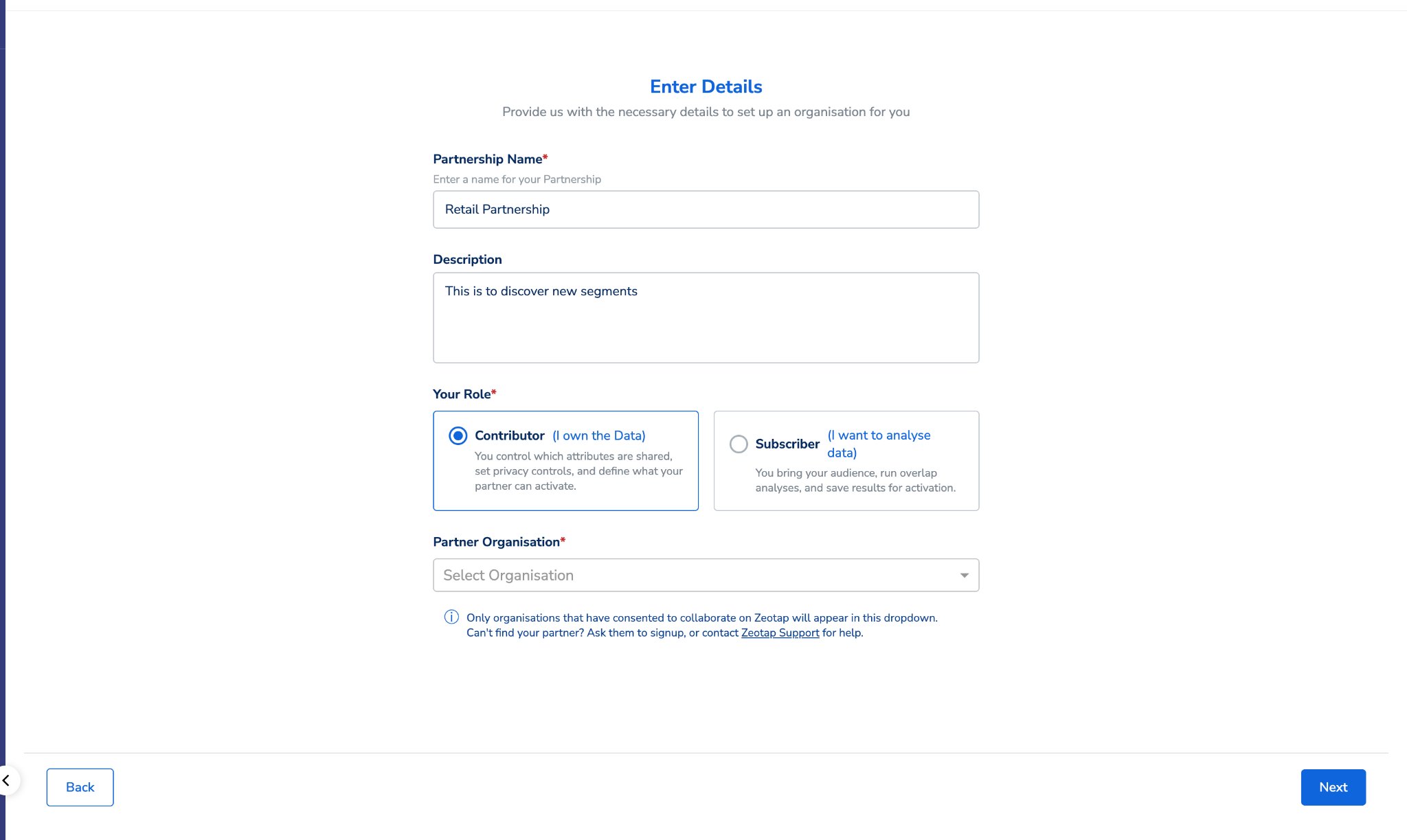
Step 2 — Contributor: Configure data sharing
You will see a two-step configuration wizard.Step 1 of 2 — Data Collaboration
1
Browse your available composable data sources on the left and expand a source to see its attributes.
2
For each attribute you want to share: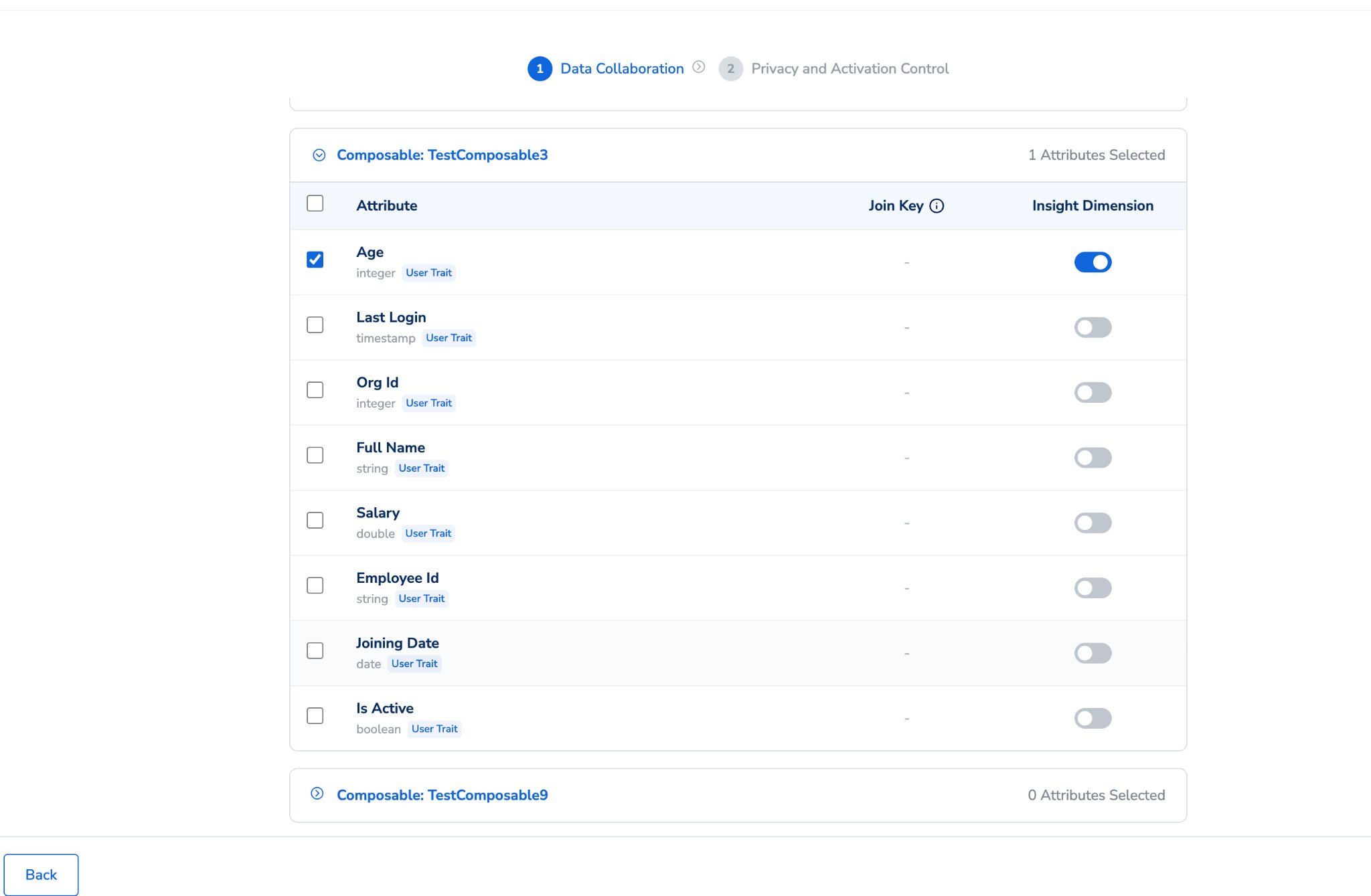
- Enable Join Key — turn this on for the identity attribute that will be used to match records with your partner. Join keys are available on ID-type attributes (such as Email MD5 or Phone MD5) and on the primary key column of composable datasets. At least one join key is required to proceed.
- Insight Dimension — turn this on for any attribute you want your partner to use in segment analysis (for example, gender, age group, or loyalty tier).
3
Click Next when done. If you click Next without selecting at least one join key, you will see an inline error — select a join key to proceed.
Publishers can only share attributes either from composable sources or from ingested sources — not a combination of both. Sharing both types together may result in duplicate records.
Step 2 of 2 — Privacy and Activation Control
1
Aggregate Threshold — the minimum group size for a cohort to appear in analysis results. Cohorts smaller than this are not shown to your partner. The default is 1,000. This ensures that overlaps below a certain size are not exposed, to avoid user re-identification.
2
Activation Settings — select Allow Activation if you want your partner to be able to save overlap results as audiences, then select which channels they can activate to.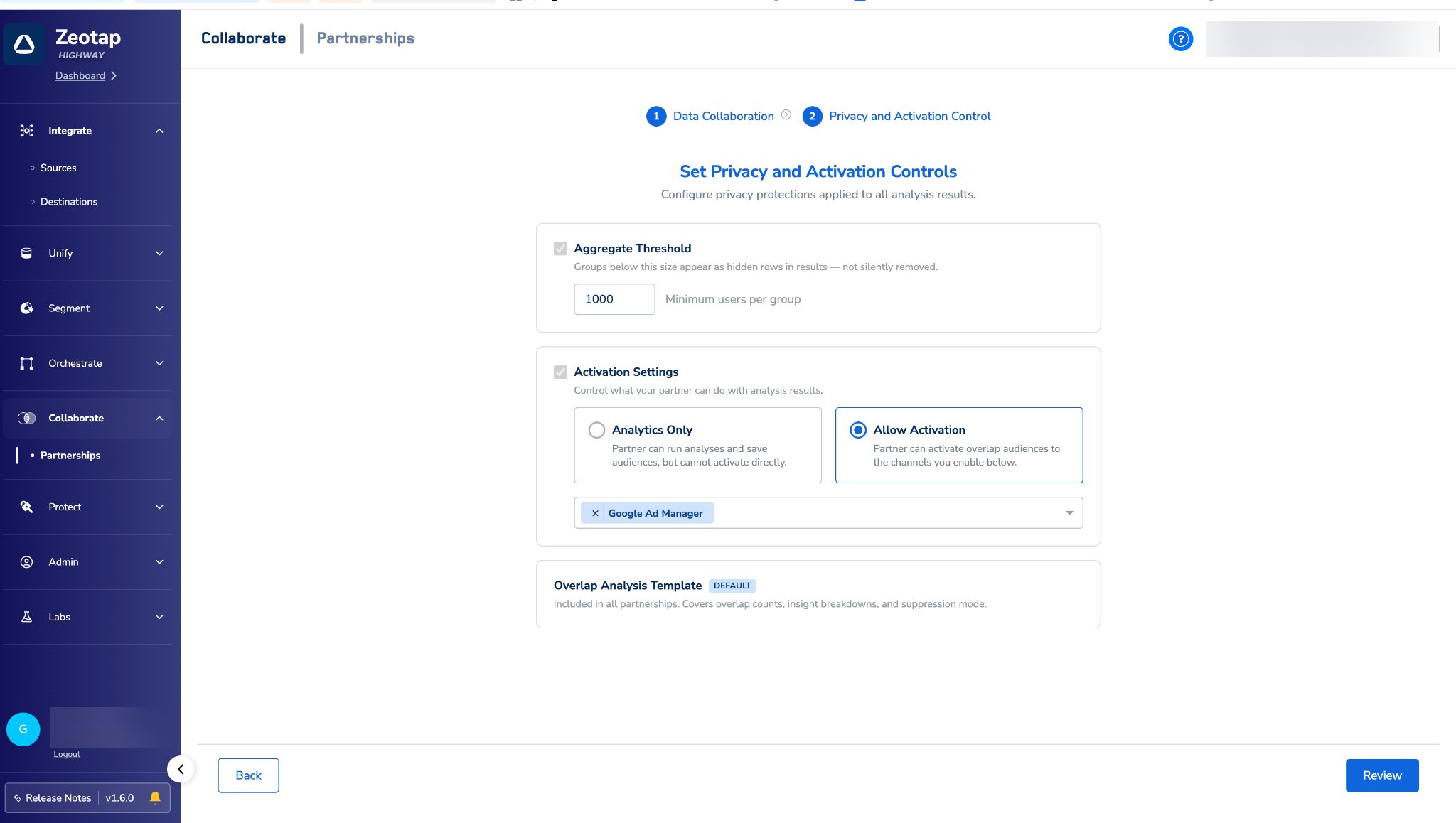
3
Click Submit.
Step 3 — Subscriber: Accept the invitation
Your CDP admins received an invitation email when the Contributor created the partnership. To accept:1
Navigate to Collaborate → Partnerships.
2
Find the partnership with Pending status and your role as Subscriber.
3
Click the partnership name, then click Accept Invitation.
Step 4 — Subscriber: Map your join keys
The configuration screen shows the join keys the Contributor has set on their side. You map each to the equivalent attribute in your data.The Subscriber configuration step is only available once the Contributor has completed their configuration. If the Contributor has not yet submitted their side, you will not see the mapping screen.
1
For each partner join key shown (for example, “Email MD5 Lowercase”), select the matching attribute from your own data.
2
Map all available join keys if possible — each mapped key increases the chance of finding matches.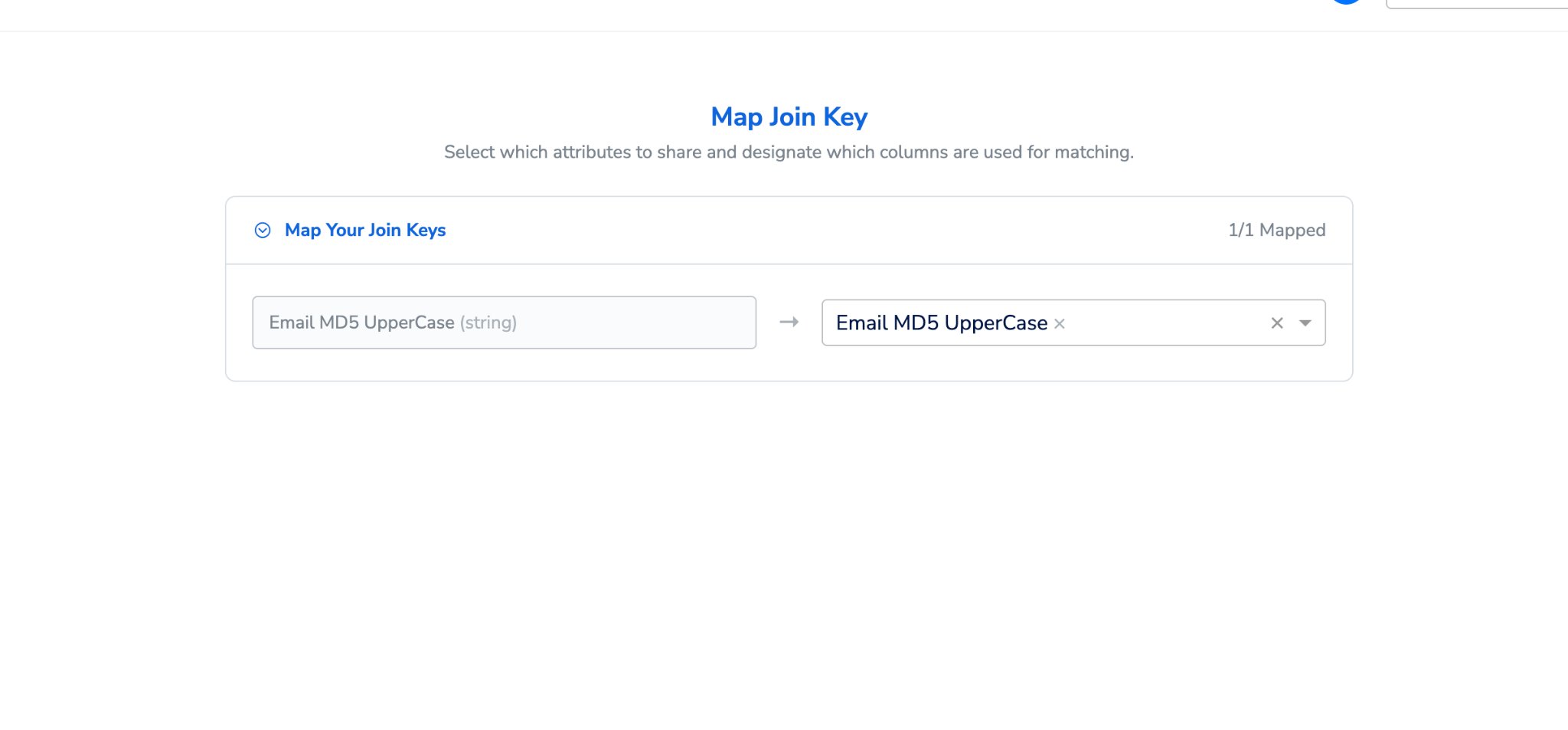
3
Click Submit.
Step 5 — Subscriber: Discover
Discover is the overlap analysis step — understand how your audience aligns with your partner’s and what those shared customers look like.1
Open the Active partnership and click the Analysis tab.
2
Under Matching on, select the join key to use for this run.
3
Click Run Analysis.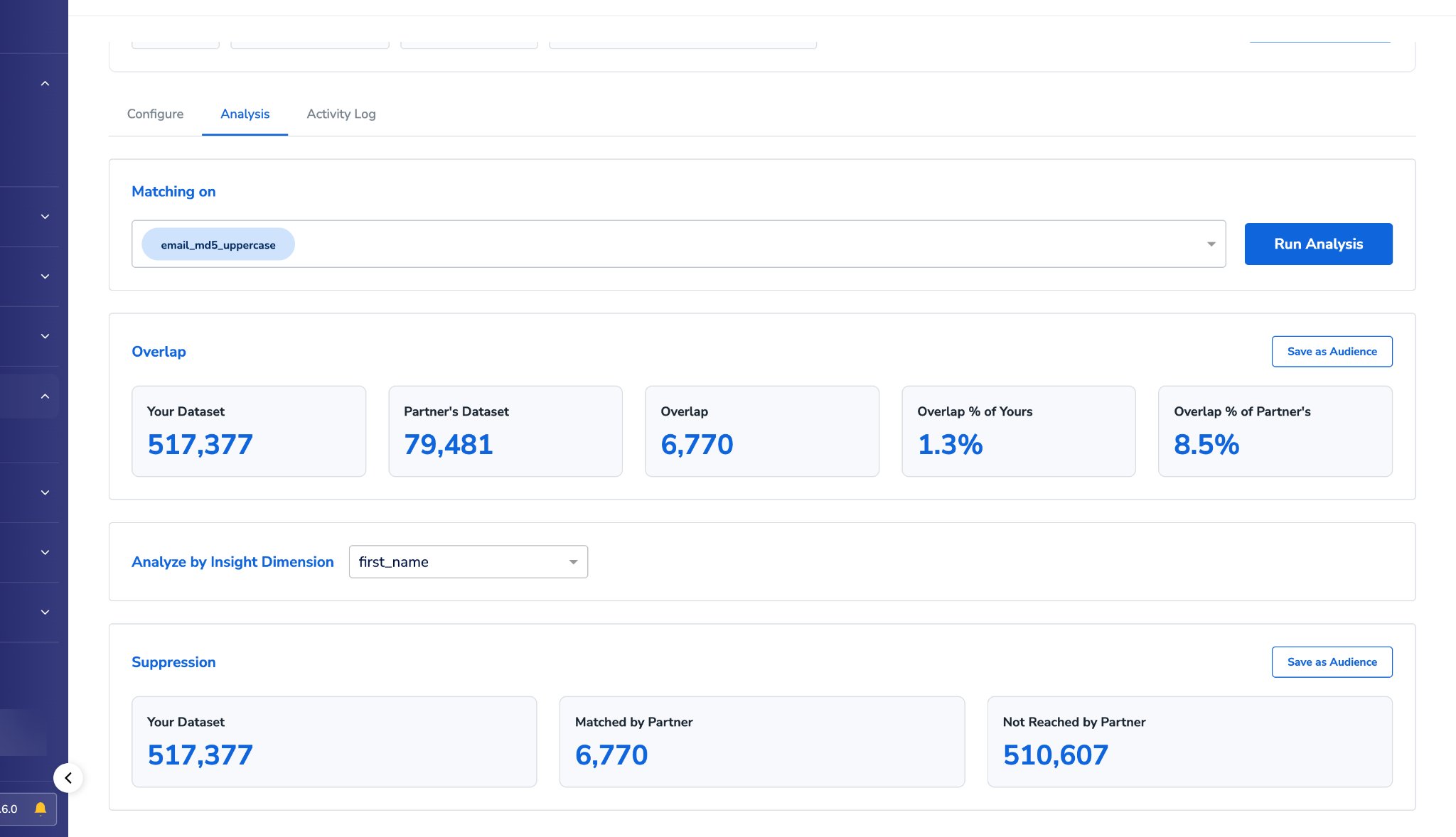
Use Analyse by Insight Dimension to select an insight dimension from the dropdown and see the overlap broken down by that attribute (for example, Gender: Male 11,678 / Female 11,800). Cohorts below the Contributor’s aggregate threshold are not shown.
Step 6 — Subscriber: Activate
Activate — save matched segments as audiences and push them to ad channels.1
In the Overlap section, click Save as Audience to save the full matched population.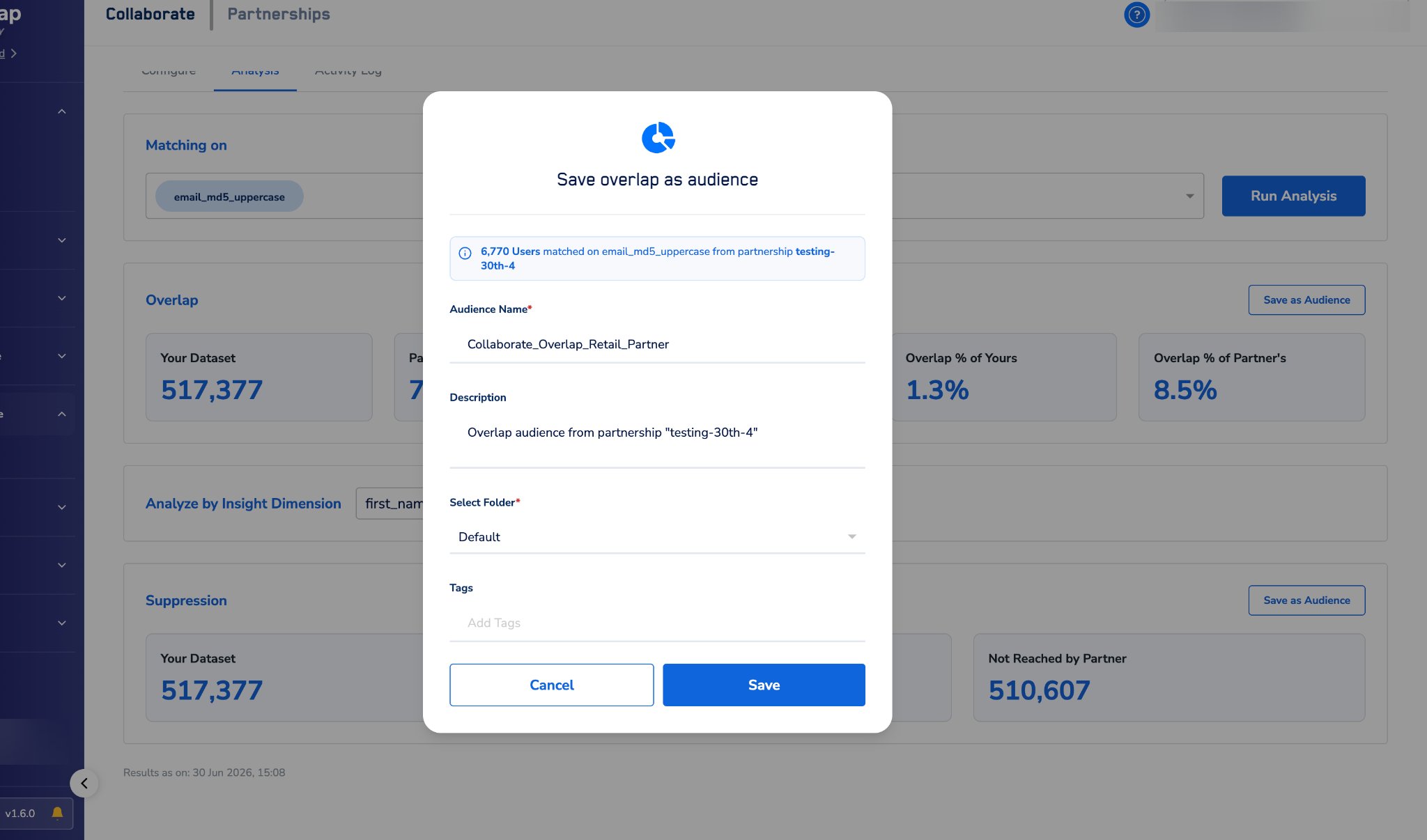
2
In the Analyse by Insight Dimension table, click Save as Audience next to a specific segment to save that breakdown as a separate audience (for example, save “Female” matched users only).
3
Saved audiences appear in Segment → Audiences and can be activated to any channel the Contributor has permitted.
Cohorts below the aggregate threshold (default 1,000 users) cannot be saved. The Save as Audience button is disabled for those rows.
Step 7 — Subscriber: Suppress
Suppress — identify customers not reached by your partner, for exclusion targeting or incrementality measurement.1
In the Suppression section of the Analysis tab, view the count of users in your dataset who were not matched by the Contributor.
2
Click Save as Audience to save this non-overlapping population as a separate audience.
3
Use this audience to exclude already-reached customers from campaigns, or to measure incremental reach.
Tracking progress
Both sides can monitor the partnership at any time via the Activity Log tab. As you work through the steps above, you will see these events appear in the log:- Invite Sent — when the Contributor created the partnership.
- Invite Accepted — when the Subscriber accepted.
- Configuration Saved — when either side submits their configuration.
- Analysis Run — when an analysis run completed, with the overlap count.
- Audience Saved — when the Subscriber saved an audience.